 PickFret
Free cheat sheet
The 8 beginner guitar chords
The eight chords most beginners learn first are the open chords C, A, G, E and D major and A minor, E minor and D minor. Each uses the first three frets and some open strings. Learn E minor first: it needs two fingers. G and C are usually the last to feel easy.
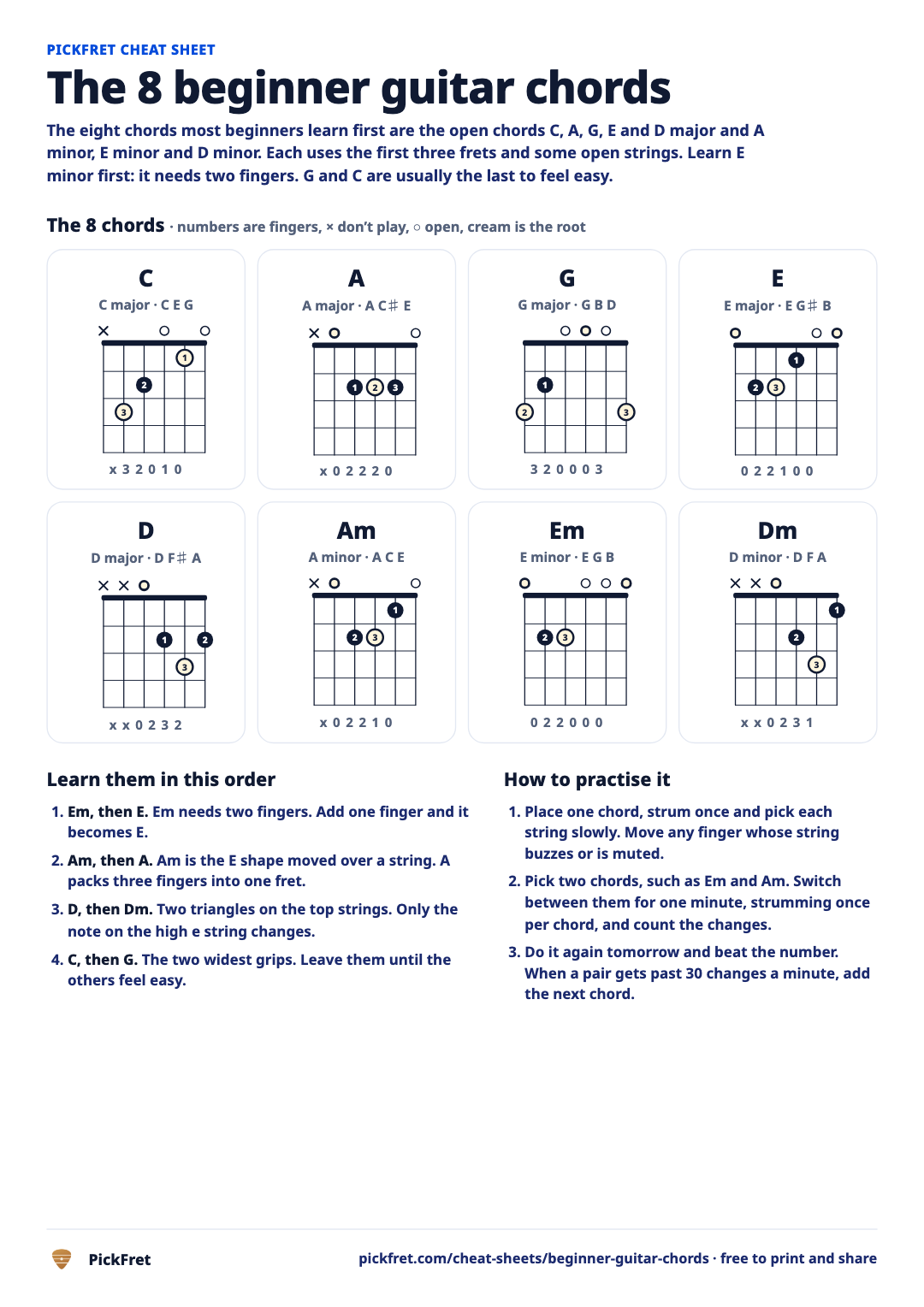
The 8 chords
Numbers in the dots are fingers: 1 is your index, 4 your little finger. An × means don’t play that string, an ○ means play it open. Cream marks the chord’s root, the note it is named after.
C
C major
Three fingers on a diagonal. The G string rings open between them.
A
A major
Three fingers squeezed into fret 2.
G
G major
The widest stretch of the eight: the top and bottom strings at fret 3.
E
E major
All six strings ring. E minor with one finger added.
D
D major
A small triangle on the top three strings. Strum four strings.
Am
A minor
The E major shape moved over one string.
Em
E minor
Two fingers and every string. Start here.
Dm
D minor
D major with the top note down a fret.
| Chord | Frets | Notes in the chord |
|---|---|---|
| C | x 3 2 0 1 0 | C E G |
| A | x 0 2 2 2 0 | A C♯ E |
| G | 3 2 0 0 0 3 | G B D |
| E | 0 2 2 1 0 0 | E G♯ B |
| D | x x 0 2 3 2 | D F♯ A |
| Am | x 0 2 2 1 0 | A C E |
| Em | 0 2 2 0 0 0 | E G B |
| Dm | x x 0 2 3 1 | D F A |
Learn them in this order
- Em, then E. Em needs two fingers. Add one finger and it becomes E.
- Am, then A. Am is the E shape moved over a string. A packs three fingers into one fret.
- D, then Dm. Two triangles on the top strings. Only the note on the high e string changes.
- C, then G. The two widest grips. Leave them until the others feel easy.
How to practise it
- Place one chord, strum once and pick each string slowly. Move any finger whose string buzzes or is muted.
- Pick two chords, such as Em and Am. Switch between them for one minute, strumming once per chord, and count the changes.
- Do it again tomorrow and beat the number. When a pair gets past 30 changes a minute, add the next chord.
Hear each chord in the chord library Opens in your browser. No account needed.
Print it
Everything above on one page, as a PDF to print or an image to keep on your phone. Free, no email needed.
Questions
What is the easiest guitar chord to learn first?
E minor. Two fingers go on fret 2 of the A and D strings and all six strings ring open, so you can strum freely from the first day.
Which chords do I need to play most songs?
G, C, D, Em and Am cover a huge number of pop, rock and folk songs, often only three or four at a time. Add A, E and Dm and you can play most beginner songbooks.
How long does it take to learn these chords?
Holding a shape takes days. Changing between shapes in time takes weeks of short daily practice. One minute of changes a day on two chords moves faster than long sessions once a week.
Why does my chord buzz?
Usually a finger is too far from its fret, or another finger leans on the next string. Press just behind the fret wire with your fingertip and keep your knuckles arched.