 PickFret
Free cheat sheet
Every note on the guitar fretboard
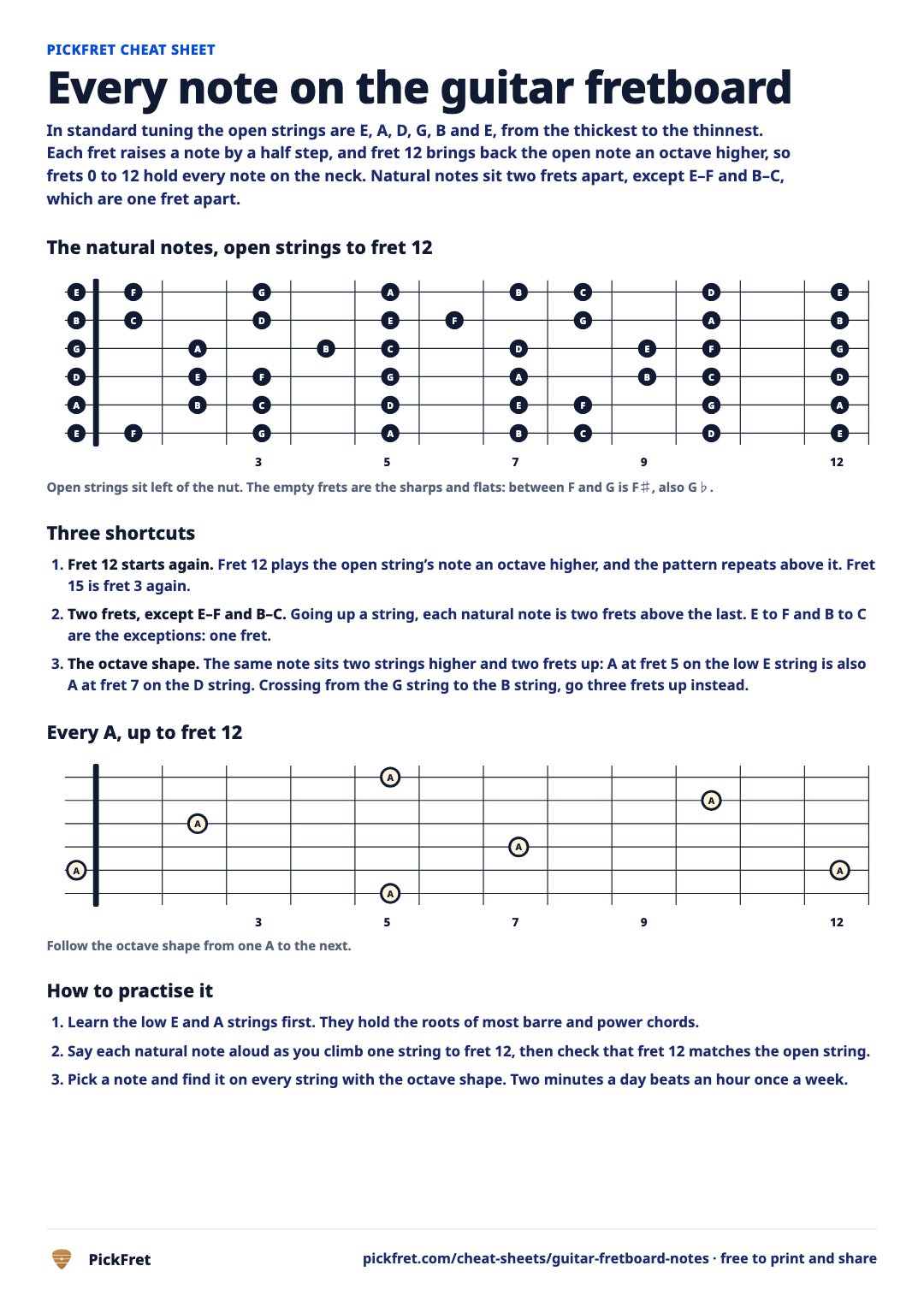
In standard tuning the open strings are E, A, D, G, B and E, from the thickest to the thinnest. Each fret raises a note by a half step, and fret 12 brings back the open note an octave higher, so frets 0 to 12 hold every note on the neck. Natural notes sit two frets apart, except E–F and B–C, which are one fret apart.
The natural notes, frets 0 to 12
The chart shows the natural notes, A to G. The empty frets between them are the sharps and flats: the fret between F and G is F♯, also called G♭.
| String | Notes (fret) |
|---|---|
| high e | E (0), F (1), G (3), A (5), B (7), C (8), D (10), E (12) |
| B | B (0), C (1), D (3), E (5), F (6), G (8), A (10), B (12) |
| G | G (0), A (2), B (4), C (5), D (7), E (9), F (10), G (12) |
| D | D (0), E (2), F (3), G (5), A (7), B (9), C (10), D (12) |
| A | A (0), B (2), C (3), D (5), E (7), F (8), G (10), A (12) |
| low E | E (0), F (1), G (3), A (5), B (7), C (8), D (10), E (12) |
Three shortcuts
- Fret 12 starts again. Fret 12 plays the open string’s note an octave higher, and the pattern repeats above it. Fret 15 is fret 3 again.
- Two frets, except E–F and B–C. Going up a string, each natural note is two frets above the last. E to F and B to C are the exceptions: one fret.
- The octave shape. The same note sits two strings higher and two frets up: A at fret 5 on the low E string is also A at fret 7 on the D string. Crossing from the G string to the B string, go three frets up instead.
How to practise it
- Learn the low E and A strings first. They hold the roots of most barre and power chords.
- Say each natural note aloud as you climb one string to fret 12, then check that fret 12 matches the open string.
- Pick a note and find it on every string with the octave shape. Two minutes a day beats an hour once a week.
Practise with random notes Opens in your browser. No account needed.
Print it
Everything above on one page, as a PDF to print or an image to keep on your phone. Free, no email needed.
Questions
How many notes are on the guitar fretboard?
Twelve different notes, A to G♯, repeat up every string. Frets 0 to 11 play each of the twelve once, and fret 12 starts the cycle again an octave higher.
Why is there no sharp between E and F or B and C?
In Western music those pairs are already a half step apart, the smallest step there is, so nothing fits between them. On a piano they are the white keys with no black key between.
Do the low E and high E strings have the same notes?
Yes. They are two octaves apart, so every fret plays the same note name on both: F at fret 1, G at fret 3, A at fret 5.
What is the fastest way to learn the fretboard?
Learn the natural notes on the low E and A strings, then use the octave shape to find the same notes on the higher strings. A few minutes of naming random notes each day works better than memorising the chart in one go.